1. A Journey Begins on Powell Street
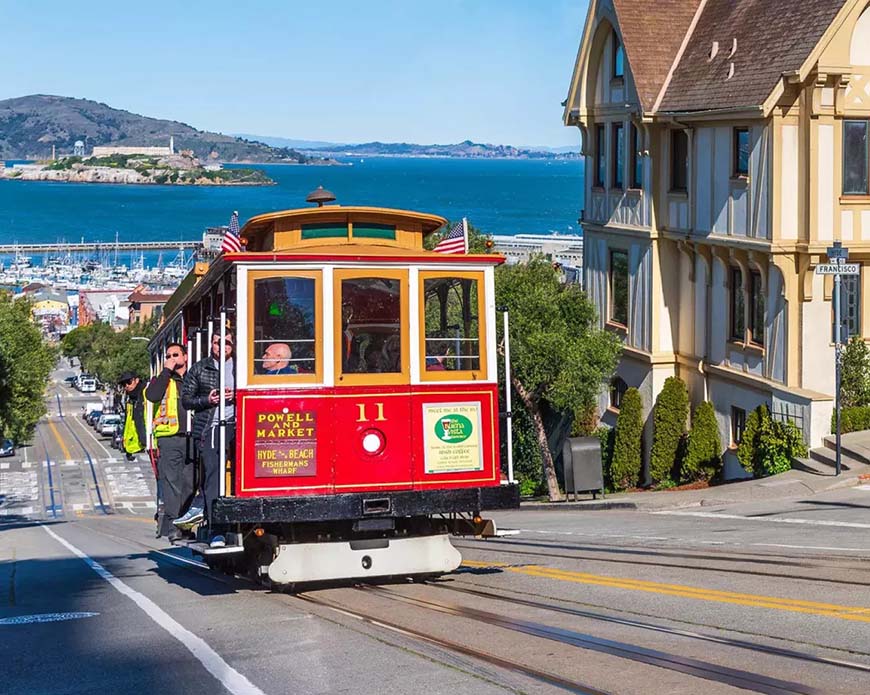
The clang of bells echoed off the tall buildings as I stepped onto Powell Street, a rhythmic metallic chime that signaled the approach of a San Francisco cable car. A foggy breeze drifted in from the bay, curling through the streets and adding a layer of romance to the already atmospheric morning. The Powell-Hyde line’s wooden car, with its cherry-red trim and polished brass fixtures, rumbled to a halt. I stepped aboard and immediately felt something shift—not just in space, but in time.
The conductor nodded, pulled a heavy lever with a practiced tug, and we began our ascent. The cable car, part mechanical marvel and part cultural treasure, moved with the confidence of something that has seen generations ride its benches. As the buildings swayed gently with the motion and the steel cable hummed beneath the street, it became clear that this was not just public transportation. This was heritage in motion.
2. History Underfoot: Steel Cables and City Dreams
Each line beneath the cable cars pulses with history. In the aftermath of the Gold Rush, San Francisco grew at a breakneck pace, its famously steep hills a daunting challenge for horse-drawn wagons. In 1873, Andrew Smith Hallidie introduced the first cable car line—a marvel of ingenuity. Rather than rely on animal labor, cars would grip a constantly moving underground cable powered by steam engines.
The original line, Clay Street Hill, is gone now, but the soul of the system remains intact. The city has preserved three active cable car lines—Powell-Hyde, Powell-Mason, and California Street—maintained through laborious care and civic pride. Today, the cable car is both a mode of travel and a mobile museum, clanking along tracks laid down over a century ago.
Riding a cable car is not about efficiency. It’s about movement through history. The wooden benches, the creak of the brakes, the smell of oil and weathered metal—these details turn a simple journey into a cinematic experience.
3. The Climb to Nob Hill
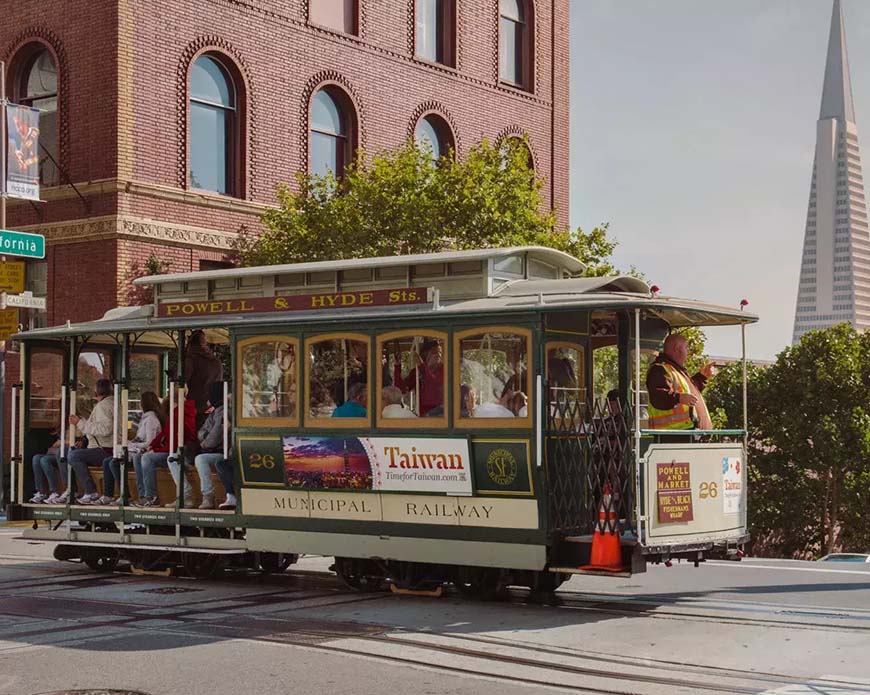
As the car groaned up the steep incline toward Nob Hill, the landscape changed. Victorian townhouses gave way to grand hotels and cathedrals. Grace Cathedral loomed at the summit, its neo-Gothic spires cutting a dramatic figure against the fog. In the early 1900s, Nob Hill was home to the “Big Four” railroad barons—Stanford, Huntington, Hopkins, and Crocker—who built opulent mansions on the city’s highest hill.
Most of those grand homes were destroyed in the 1906 earthquake, but their legacy endures. The Fairmont Hotel, opened just days after the disaster, stands as a monument to resilience and elegance. The clang of the cable car’s bell reverberated against its white stone façade as we rolled past. It felt momentous, as though one was riding through a scene prewritten into the city’s collective memory.
A young couple sat across from me, craning their necks to take in the views. Down each cross-street, the entire city seemed to open up—grids of pastel homes, the azure shimmer of the bay, distant sailboats cutting arcs toward Alcatraz.
4. Descending to Russian Hill
On the Powell-Hyde line, the route begins to descend after Nob Hill, leading into Russian Hill, one of the city’s oldest neighborhoods. The descent is thrilling. As the car tips forward, it feels as though gravity will take over completely. The gripman adjusts the cable with precise movements, the brakes hiss, and the car slows as it approaches Lombard Street—the “crookedest street in the world.”
Tourists leaned out with cameras. The driver, unfazed, posed for photos with an almost theatrical charm. The stop here was brief, but enough to marvel at the twisting red-brick path below. Bougainvillea bloomed along the curves, and the manicured gardens looked like something out of a Victorian postcard. Further down, the steep incline offered a view straight to the bay, with the Ghirardelli sign and Aquatic Park anchoring the end of the line.
5. Wharfside Whispers: Hyde Street and the Waterfront
When the car reached Hyde and Beach, the air shifted again. Salty and brisk, it hinted at nearby sea lions and fresh seafood. Fisherman’s Wharf stretched along the waterfront with its wooden piers, seafood stalls, and the constant activity of tourists mingling with seagulls.
Disembarking, I wandered down Pier 39 and caught the sight of the famous sea lions lounging noisily. Street performers juggled and played old jazz tunes near the carousel, while crab vendors stirred massive pots of chowder. It’s easy to be cynical about touristy spots, but here, the pageantry felt authentic. The waterfront has always been a gateway—first for ships, then for ideas, and now for visitors seeking connection.
The cable car turnaround at Hyde Street is a spectacle in itself. Operators must physically push the car around on a rotating wooden platform, aligning it perfectly for the next uphill journey. Watching them work is like observing a ritual passed down through generations. There’s pride in it. Precision. And when the bell rings once more, the cycle begins anew.
6. A Ride on the California Street Line
Later, I boarded the California Street line, less crowded but equally mesmerizing. This route runs east to west, starting near the Financial District and heading toward Van Ness Avenue. Unlike the Powell lines, these cars are double-ended—no need for a turnaround platform.
The California line offers a different perspective. The climb through the city’s business core is quiet, a contrast to the tourist frenzy. High-rises, law offices, and consulates line the streets. Yet, even here, the cable car feels out of place in the most charming way—like a grandfather clock standing proud in a modern penthouse.
As we ascended into Chinatown, the architectural style shifted dramatically. Pagoda roofs, red lanterns, and golden dragon motifs marked a vibrant cultural enclave. The cable car passed directly through the heart of this district, weaving a path between incense-scented shops and herbal medicine stores. The car seemed to carry not just passengers, but stories—of immigrants, resilience, festivals, and fusion.
7. Inner Rhythms and Outer Landscapes
There’s a meditative quality to a long cable car ride. The city slows down; attention sharpens. The rhythm of the ride—the start-stop motion, the ringing bell, the conductor’s call—is like a drumbeat. Each street corner opens a new scene. A mural painted on a garage door. Children skipping rope on a stoop. A jazz band rehearsing behind an open window.
Looking out at the ever-changing landscape, it’s impossible not to marvel at how San Francisco’s topography shapes its identity. The hills are not obstacles—they are characters in the story. They force interaction. They demand engineering. They reveal or obscure the view, depending on one’s elevation.
8. Sunset on the Tracks
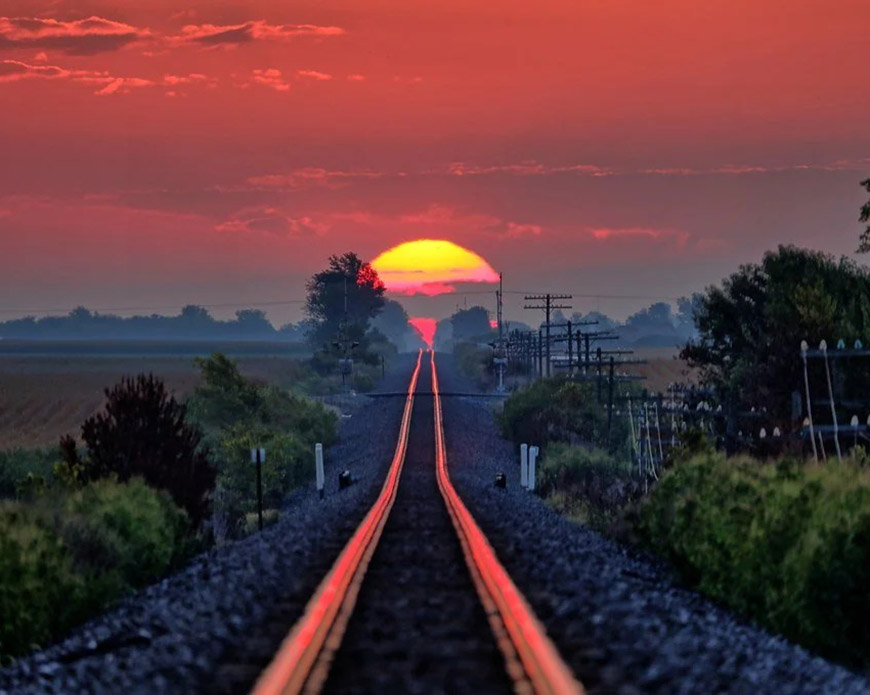
In the evening, I rode once more—this time catching the golden hour from the back platform of a Powell-Mason car. The sun dipped low, igniting the Victorian facades with warmth. The city shimmered in gold, then amber, and finally blue as night crept in. Overhead, wires crisscrossed the sky like constellations made by man. The familiar clang of the bell now felt like punctuation to a well-spoken sentence.
As we rolled downhill toward Bay Street, city lights blinked on. Streetlamps flickered. The breeze carried the scent of garlic and butter from North Beach trattorias. The sounds of traffic were softened by the click of steel wheels and the hum of the cable beneath us.
9. Mechanics and Magic: A Visit to the Cable Car Museum
The next morning, I paid a visit to the Cable Car Museum on Mason Street. Located inside a historic cable car barn, the museum houses the actual winding machinery that powers the underground cables. Enormous wheels turned slowly but forcefully, pulling the endless loops of steel cable through the city’s underbelly.
The machinery was mesmerizing. Each wheel moved with steady, unhurried purpose, much like the cable cars themselves. In the upper gallery, historic cars were on display, some dating back to the 1870s. Tools, photographs, and conductor uniforms lined the walls. Down below, a live view of the working powerhouse connected the abstract idea of “infrastructure” with the lived experience of the ride.
It was deeply satisfying to witness the inner workings of the system I had been riding. This was not a simulation or exhibit—it was the real mechanism keeping the city’s historic heart beating.
10. The Human Element: Conductors and Gripmen
Every ride is shaped by the operators—the gripmen, conductors, and engineers who keep the cars running. Their role is not simply mechanical. They are guardians of tradition, entertainers, and storytellers. Each one I met had a different style. Some were stoic, eyes focused on the track. Others cracked jokes, posed for photos, offered commentary on the views.
One conductor shared stories of celebrities he had driven. Another offered restaurant recommendations between stops. Most impressive was the physical strength and precision needed to operate the grip—a task that requires sharp timing and attention to avoid accidents. The training takes years. The respect they command is well-earned.
11. Ephemeral and Eternal: The Soul of the City
As I stood once more at a cable car stop, waiting to board a ride that would take me back across familiar hills, I watched a small child point with wonder as the car approached. Her mother lifted her onto the platform and the gripman smiled. A family from Germany climbed aboard with awe-struck expressions. Locals, too, squeezed on—carrying groceries, briefcases, gym bags.
There’s something profoundly democratic about the experience. Rich or poor, native or visitor, child or elder—everyone is equal on a cable car bench. The ride is bumpy. The wind is brisk. The bell is loud. But in that shared experience lies the soul of the city—resilient, diverse, beautifully imperfect.
Cable cars are not just a way to traverse San Francisco. They are a way to feel it, to breathe it, to understand it at a tempo too easily lost in the speed of modern life. Every ride is a rolling archive, every grip a connection to the past, and every bell a celebration of movement not just through space, but through memory.